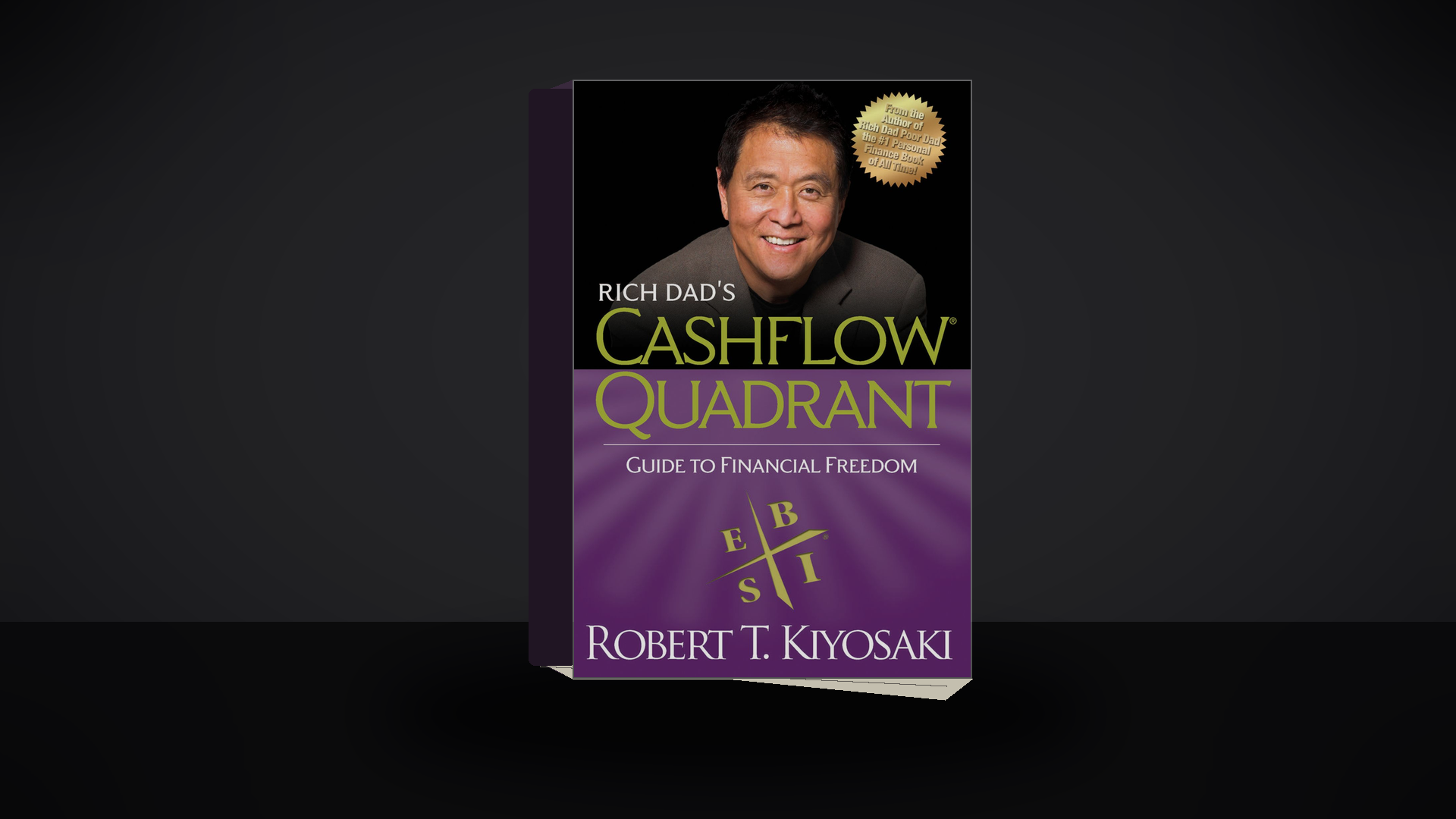


A review of Cashflow Quadrant and the uncomfortable truth that higher status, more clients or more income can still leave you less free.
Robert Kiyosaki’s Cashflow Quadrant explains why a prestigious career or thriving small business can still become a financial prison—and why changing quadrants is harder than it looks.
Imagine waking in the middle of the night with a realization you have spent years trying not to confront.
You have succeeded.
You earned the promotion. Your salary is higher than ever. Your house looks respectable, your car signals progress, and your calendar is full of responsibilities that apparently prove how important you have become.
Or perhaps you escaped employment and built your own business. Customers know your name. Revenue is growing. Nobody tells you when to arrive at work.
Yet the moment you stop working, the money stops too.
Your success does not belong to you. You belong to it.
That is the unsettling premise behind Robert Kiyosaki’s Rich Dad’s Cashflow Quadrant. The book argues that the source of your income matters at least as much as the amount you earn. Two people can make precisely the same annual income while occupying completely different financial worlds.
One owns a demanding job.
The other owns a system.
One must repeatedly sell time to keep the income flowing.
The other has built assets, people, or processes capable of producing income without requiring constant personal involvement.
This distinction makes Cashflow Quadrant one of Kiyosaki’s most useful books. It moves beyond the familiar advice to “earn more” and asks a more disturbing question:
What must continue happening for your income to arrive?
But, as with Rich Dad Poor Dad, Kiyosaki’s framework is more persuasive as a psychological model than as a complete economic theory. Employees are not automatically prisoners. Business owners are not automatically free. Investors do not merely sit beside swimming pools while money reproduces in the background.
The quadrant describes four ways of earning income. It does not guarantee what kind of life each one will produce.
That distinction changes everything.
The Four Ways Money Enters Your Life
Kiyosaki divides income earners into four quadrants:
The left side contains Employees and the Self-Employed. Their income usually depends heavily on their continued labor.
The right side contains Business Owners and Investors. Their income is theoretically produced through systems, ownership, capital, and the efforts of other people.
This looks simple on paper. Life is less cooperative.
A senior employee with stock ownership, a generous pension, and a diversified investment portfolio may occupy several quadrants simultaneously. A freelancer may eventually create an agency that operates without her. A supposedly passive property investor may discover that tenants, boilers, regulations, and midnight telephone calls have converted his investment into an unusually inconvenient job.
The quadrant is therefore not a rigid classification of people. It is a way to examine the machinery behind their income.
The Employee: Security With Conditions
The Employee seeks predictability.
A known salary arrives on a known date. The employer may provide paid leave, insurance, retirement contributions, training, legal protections, and a degree of stability that entrepreneurship cannot promise.
Kiyosaki tends to present this desire for security as evidence of fear. That is too dismissive.
Security has real economic value. A dependable salary can support a family, finance education, provide access to credit, build an emergency reserve, and supply the capital needed to invest. For many people, employment is not the opposite of wealth creation. It is what makes wealth creation possible.
The danger appears when income and dependency grow together.
A promotion increases the salary, but it may also increase the mortgage, car payment, school fees, subscriptions, and social expectations. The employee earns more but becomes less capable of surviving without the job.
The problem is not receiving a paycheck.
The problem is constructing a life that must receive the next one.
This is how golden handcuffs are made. The gold comes from the employer. The employee often helps manufacture the cuffs.
A job can be an instrument of freedom when part of its income is converted into savings, productive assets, valuable skills, and ownership. It becomes confining when every raise is immediately transformed into a more expensive standard of living.
Security is not an illusion simply because it is incomplete. But employment becomes fragile when it is the household’s only functioning financial engine.
The Self-Employed: When Independence Creates Another Boss
The Self-Employed person rejects dependence on an employer.
This quadrant includes consultants, tradespeople, physicians, lawyers, freelancers, shopkeepers, creators, and small-business owners whose customers primarily pay for their personal work or expertise.
They value independence and control. They know how they want the work performed and often believe—sometimes correctly—that nobody can meet their standards as well as they can.
This can produce excellent work.
It can also produce an owner who is unable to leave.
If every quotation requires your approval, every client expects your personal attention, and every operational problem eventually reaches your telephone, you may own the business legally without owning your time economically.
You did not eliminate the boss. You distributed the boss among your customers.
The successful self-employed professional can become trapped precisely because success creates more demand for the one resource that cannot be expanded: personal time.
More clients create more revenue, but also more meetings.
A stronger reputation creates more opportunities, but also more expectations.
Hiring someone feels risky because customers supposedly “want you.” Delegating feels dangerous because your identity is tied to the quality of the work. Eventually, the business becomes profitable but structurally dependent on its founder.
This is the tragedy of the S quadrant: the owner may have escaped employment without escaping labor dependence.
The critical test is simple:
If you disappeared for six months, would the business continue serving customers, paying employees, and producing profits?
If not, you may own an excellent job.
That is not an insult. A profitable independent practice can provide autonomy, purpose, and substantial income. But it should not be confused with a business that functions independently of its owner.
The Business Owner: Building the Machine
Kiyosaki’s Business Owner does not merely perform the work. The Business Owner builds the system through which the work is performed.
This requires a different psychological orientation.
The self-employed specialist asks:
- “How can I do this properly?”
- The system builder asks:
- “How can this be done properly without depending permanently on me?”
That question changes the role of the founder.
Instead of being the organization’s most exhausted employee, the founder designs processes, recruits people, establishes incentives, allocates capital, creates controls, and gradually removes personal intervention from routine operations.
The objective is not to become useless. It is to stop being operationally indispensable.
This is more difficult than Kiyosaki sometimes makes it sound. People do not magically organize themselves. Systems require monitoring. Employees need leadership. Incentives can produce unintended behavior. Competition changes. Customers leave. Technology makes yesterday’s business model obsolete.
A business that once operated smoothly can begin deteriorating while its owner is proudly practising “passive income” on a beach.
Real business ownership is not freedom from responsibility. It is a shift from performing individual tasks to accepting responsibility for the system as a whole.
The business also needs genuine scalability. A freelance designer who hires one assistant has not necessarily constructed a self-sustaining enterprise. A restaurant with fifty employees may still collapse when the founder leaves. Meanwhile, a small digital product can sometimes serve thousands of customers with limited additional labor.
Size does not determine the quadrant.
Dependence does.
The true B-quadrant question is not how many people work for you. It is whether the organization’s value creation has been separated from your continuous personal labor.
The Investor: When Capital Becomes the Employee
The Investor allocates money to assets with the expectation of receiving future income, appreciation, or both.
In this quadrant, capital performs the labor.
Shares can provide ownership in productive companies. Bonds can generate interest. Real estate can produce rent. Private businesses can distribute profits. Intellectual property can generate royalties.
This is the closest the quadrant comes to genuine financial independence because investment income does not necessarily require the investor to trade another hour for another euro or dollar.
But the phrase “money working for you” can make investing sound suspiciously effortless.
Capital does not work. Businesses, employees, managers, tenants, borrowers, technologies, and legal institutions work. Capital gives its owner a claim on part of the resulting cash flow.
That claim carries risk.
Companies fail. Borrowers default. Property requires maintenance. Markets reprice assets. Inflation reduces purchasing power. Leverage magnifies losses as faithfully as it magnifies gains.
The successful Investor is therefore not merely a person with money. The successful Investor understands valuation, cash flow, risk, incentives, diversification, liquidity, taxation, and the limits of personal knowledge.
Passive income is usually the reward for previously active decisions—and occasionally for active mistakes that have not yet become visible.
Why Success Can Reduce Freedom
The most interesting idea in Cashflow Quadrant is not that the right side is rich and the left side is poor. That is obviously untrue.
Highly paid employees may accumulate substantial wealth. Small-business owners may earn more than investors. Business founders can lose everything. Retired workers with disciplined portfolios may enjoy greater freedom than entrepreneurs still explaining to everyone how passive their businesses are.
The more valuable insight is that success can deepen dependence on the mechanism that created it.
A talented employee receives more responsibility.
A popular consultant receives more clients.
A respected physician receives more patients.
A successful shop owner opens longer hours.
Their income rises, but so does the amount of personal effort required to sustain it.
This produces a peculiar form of progress: the numbers improve while the available life becomes smaller.
The calendar fills. The vacations shorten. The telephone follows its owner into every room. Family time becomes something scheduled between professional obligations.
From the outside, this resembles success.
From the inside, it can feel like a hostage negotiation conducted with your own ambition.
The problem is not hard work itself. Hard work can be meaningful, necessary, and temporary. The problem is hard work without conversion.
If years of labor do not gradually produce assets, systems, skills, reputation, or ownership that reduce future dependence, then success may simply construct a more luxurious treadmill.
The Psychology of Staying Where You Are
Changing quadrants is difficult because each one rewards a different kind of behavior.
Employees are often rewarded for reliability, specialization, cooperation, and avoiding costly mistakes.
Self-employed professionals are rewarded for personal excellence, control, responsiveness, and reputation.
Business Owners must learn to delegate, tolerate work being performed differently, design systems, evaluate people, and accept that control over every detail prevents scale.
Investors must commit capital without certainty, endure volatility, think probabilistically, and distinguish a temporary decline from a permanent loss.
Moving from one quadrant to another therefore involves more than changing legal structures or opening a brokerage account. It requires abandoning some behaviors that previously created success.
That is psychologically painful.
The excellent specialist must stop proving that nobody else can perform the work.
The cautious employee must accept that some outcomes cannot be guaranteed.
The new investor must learn that uncertainty does not disappear merely because a spreadsheet contains two decimal places.
The founder must discover that delegation without controls is negligence, while control without delegation is captivity.
Kiyosaki is right that fear of failure can prevent movement. But fear is not always an irrational obstacle. Sometimes it is information.
Leaving a stable job without savings, customers, expertise, or a credible plan is not bravery. It is unemployment with motivational vocabulary.
The objective is not to eliminate fear. It is to identify which risks are real, which can be reduced, and which must be accepted because meaningful progress cannot be guaranteed in advance.
Other People’s Time and Other People’s Money
Kiyosaki emphasizes two forms of leverage:
OPT: Other People’s Time
OPM: Other People’s Money
These concepts explain how economic activity can expand beyond the founder’s personal hours and personal capital.
A business hires employees and specialists whose combined time allows the organization to serve more customers than the owner could serve alone. Investors provide capital that enables expansion. Banks lend against expected cash flows or collateral. Suppliers may provide credit. Partners contribute expertise and resources.
Leverage makes scale possible.
It also creates obligations.
“Other People’s Time” means salaries, leadership, employment law, organizational culture, and responsibility for people whose livelihoods may depend on your decisions.
“Other People’s Money” means interest, covenants, reporting requirements, diluted ownership, repayment risk, or an investor who understandably expects a return.
OPM is not free money. It is capital accompanied by another person’s claim.
Used intelligently, leverage can accelerate the construction of productive assets. Used carelessly, it allows mistakes to become larger and arrive sooner.
Borrowing to acquire a cash-generating asset at a sensible price is not economically equivalent to borrowing for consumption. Yet even productive leverage can become dangerous when interest rates rise, revenue declines, refinancing disappears, or the asset was never worth what the optimistic buyer paid.
The person using leverage should therefore ask:
What does the capital cost?
What cash flow supports it?
What happens in a severe downturn?
Who absorbs the first loss?
Which rights have been surrendered?
Can the obligation survive without heroic assumptions?
Leverage is not the secret weapon of the rich.
It is an amplifier.
Whether it amplifies intelligence or stupidity depends on what existed before the borrowed money arrived.
The Myth That Employees Never Use Leverage
Kiyosaki’s framework sometimes implies that people on the left side rely exclusively on their own time and heavily taxed income, while those on the right use systems, tax structures, and outside capital.
Reality is more complicated.
Employees routinely invest in companies that use thousands of other people’s time. Their pension funds may own businesses, bonds, infrastructure, and property. A homeowner uses bank capital through a mortgage. A professional may hold shares in an employer, operate a side business, and own income-producing assets.
Likewise, many people who call themselves Business Owners have merely created demanding jobs financed with personal guarantees. Many investors still depend on employment income to fund their portfolios.
Most financially resilient people do not live entirely inside one quadrant. They combine them.
They may use employment for dependable income, self-employment for specialized opportunities, business ownership for scale, and investments for long-term independence.
The goal is not necessarily to migrate ceremonially from the left side to the right and burn the bridge behind you.
The goal is to prevent any single income source from possessing absolute power over your life.
Savers Are Not Losers
Kiyosaki often criticizes savers because inflation reduces the purchasing power of cash over time.
The underlying warning is valid. Money earning less than inflation loses purchasing power. Holding all long-term wealth in cash is unlikely to produce financial independence.
But “savers are losers” is the kind of slogan that sounds courageous immediately before a liquidity crisis.
Cash serves purposes that investments cannot always serve safely.
An emergency reserve prevents an unexpected expense from forcing you to sell assets during a market decline. Cash supports near-term obligations. It creates bargaining power, reduces dependence on credit, and allows an investor to act when opportunities appear.
The mistake is not saving.
The mistake is expecting cash designed for stability and liquidity to produce the long-term returns of risky assets.
Money needed soon should not be forced to audition for the stock market.
Money not needed for many years should not necessarily spend its entire life asleep in a bank account.
A mature financial plan gives cash and investments different jobs. It does not declare one morally superior to the other.
The Five Investor Levels—and Their Hidden Problem
Kiyosaki describes levels of investors ranging from people with nothing available to invest to sophisticated capitalists who use teams, legal structures, and outside money.
The progression captures something important: financial sophistication increases when people move from consuming everything they earn toward allocating capital deliberately.
But intelligence should not be measured by complexity alone.
A person who automatically invests in diversified, low-cost funds may appear less sophisticated than someone operating through companies, advisers, property partnerships, and leveraged deals. Yet the simpler investor may achieve better results with lower costs, fewer conflicts of interest, and substantially more sleep.
Complexity is not proof of intelligence.
Sometimes complexity is necessary. Large transactions require legal, accounting, tax, operational, and technical expertise. A capable investor knows when specialists add value.
But advisers do not remove responsibility. They may possess incentives that differ from the client’s. Borrowed money does not turn an ordinary deal into an elite one. A corporation does not make a weak investment profitable. Tax efficiency cannot rescue an asset that destroys capital before taxes.
The highest level of investing is not using the largest number of sophisticated tools.
It is understanding which tools are unnecessary.
Corporations Do Not Make Taxes Disappear
Kiyosaki also presents corporations as instruments through which Business Owners and Investors reduce taxes and protect wealth.
Legal structure certainly matters. Companies can separate ownership from operations, facilitate investment, provide continuity, and under certain conditions limit liability. Legitimate business expenses may reduce taxable profit. Different forms of income may receive different tax treatment depending on the jurisdiction.
But a company is not a magical doorway through which private consumption exits the tax system.
Personal expenses do not become deductible merely because a business owner pays them from a corporate account. Limited liability can be weakened by personal guarantees, fraud, improper conduct, or failure to respect the separation between the company and its owner.
The law differs substantially across countries. So do the rules governing salaries, dividends, capital gains, value-added taxes, corporate profits, deductions, and director liability.
The useful lesson is not that the rich have discovered how to stop paying tax.
It is that the legal form, timing, and source of income influence financial outcomes—and that these rules should be understood before major decisions are made.
A corporate structure can support a sound business.
It cannot transform personal spending into financial genius.
What Schools Actually Teach
Kiyosaki argues that conventional education conditions students for the E and S quadrants. Schools reward correct answers, individual performance, credentials, and avoidance of failure. The right side, by contrast, supposedly rewards experimentation, leadership, calculated risk, and learning from mistakes.
There is truth in the criticism.
Many students complete years of education without learning how to interpret financial statements, evaluate investments, understand taxes, compare loans, negotiate contracts, or recognize the difference between revenue and profit.
But formal education is not merely an indoctrination tunnel designed to produce obedient employees.
Education builds human capital. It can develop literacy, mathematics, technical competence, research ability, discipline, and professional expertise. These abilities can increase income and improve entrepreneurial and investment decisions.
The problem is not that schools teach people how to become employees.
The problem is that people sometimes mistake employability for complete financial education.
A degree may help you earn money. It does not automatically teach you what to do with the money after it arrives.
That second education remains your responsibility.
Moving Right Without Jumping Blindly
The most dangerous interpretation of Cashflow Quadrant is that readers should abandon employment immediately and rush toward entrepreneurship or leveraged investing.
That would confuse direction with timing.
A responsible transition can be gradual.
An Employee can build an emergency reserve, acquire investment knowledge, develop a side income, and begin purchasing productive assets.
A Self-Employed professional can document recurring work, standardize delivery, automate administration, train others, and reduce dependence on personal availability.
A small-business owner can identify the decisions only the founder can make—and question why so many decisions still appear on that list.
An aspiring Investor can begin with understandable assets, modest amounts, diversified exposure, and no leverage until experience justifies greater complexity.
The objective is not to perform a dramatic escape.
It is to build optionality.
Each additional income source, valuable skill, functioning system, and productive asset reduces the power of any single employer, customer, lender, or market over your future.
Freedom is usually constructed before it is announced.
A Better Version of the Cashflow Quadrant
Kiyosaki presents the right side as the destination. A more useful interpretation treats all four quadrants as tools.
Employment can provide stability and capital.
Self-employment can provide autonomy and direct rewards for expertise.
Business ownership can create scale.
Investing can convert accumulated capital into future income.
Each quadrant has advantages. Each has characteristic risks.
The Employee risks dependence on an organization.
The Self-Employed person risks becoming inseparable from the work.
The Business Owner risks operational complexity, personnel problems, competition, and failure at scale.
The Investor risks losing capital through ignorance, leverage, valuation errors, fraud, or ordinary uncertainty.
Financial intelligence means knowing which combination suits your abilities, responsibilities, temperament, and stage of life.
Not everyone needs to build a large company.
Not everyone should borrow money to invest.
Not everyone wants employees.
And not every form of freedom must produce income while its owner sleeps.
A teacher with modest expenses, meaningful work, a pension, and a growing investment portfolio may be freer than a heavily leveraged entrepreneur whose business technically operates without him but occupies every waking thought.
The quadrant reveals the structure of income.
It does not measure the quality of a life.
The Real Escape
Rich Dad’s Cashflow Quadrant is most valuable when read as a warning against dependence rather than a command to become an entrepreneur.
Its central question deserves to survive all the exaggeration:
Does your income depend completely on your continued labor, or are you gradually building something that can outlive today’s effort?
That “something” need not be a multinational corporation.
It can be a portfolio, a pension, a small systemized company, intellectual property, rental income, profit-sharing, or a combination of several sources. The form matters less than the direction.
Today’s labor should purchase more than today’s consumption.
It should acquire part of tomorrow.
Kiyosaki is right that people can become hostages to their own success. A higher income can finance larger obligations. A growing practice can consume its founder. A prestigious position can become impossible to leave because status and spending have quietly reorganized themselves around it.
But the enemy is not employment.
The enemy is unexamined dependence.
The goal is not to stop working. It is to reach the point where work is increasingly governed by choice rather than financial panic.
Build reserves. Acquire productive assets. Create systems. Learn to delegate. Understand risk before using leverage. Use companies for genuine business purposes. Treat outside capital as an obligation, not a gift. Preserve the valuable parts of security while reducing your dependence on any single source of it.
The Cashflow Quadrant is not a map containing four prison cells.
It is a mirror.
It shows you what must happen tomorrow for money to arrive—and what would happen if it did not.
Your current quadrant does not determine your worth.
But if all your income stops the moment you do, it may determine far too much of your freedom.
This article is an independent review and analysis inspired by Robert T. Kiyosaki’s Rich Dad’s Cashflow Quadrant. It is not accounting, legal, tax, or investment advice. Business structures, liability protections, and tax consequences vary by jurisdiction and personal circumstances.