
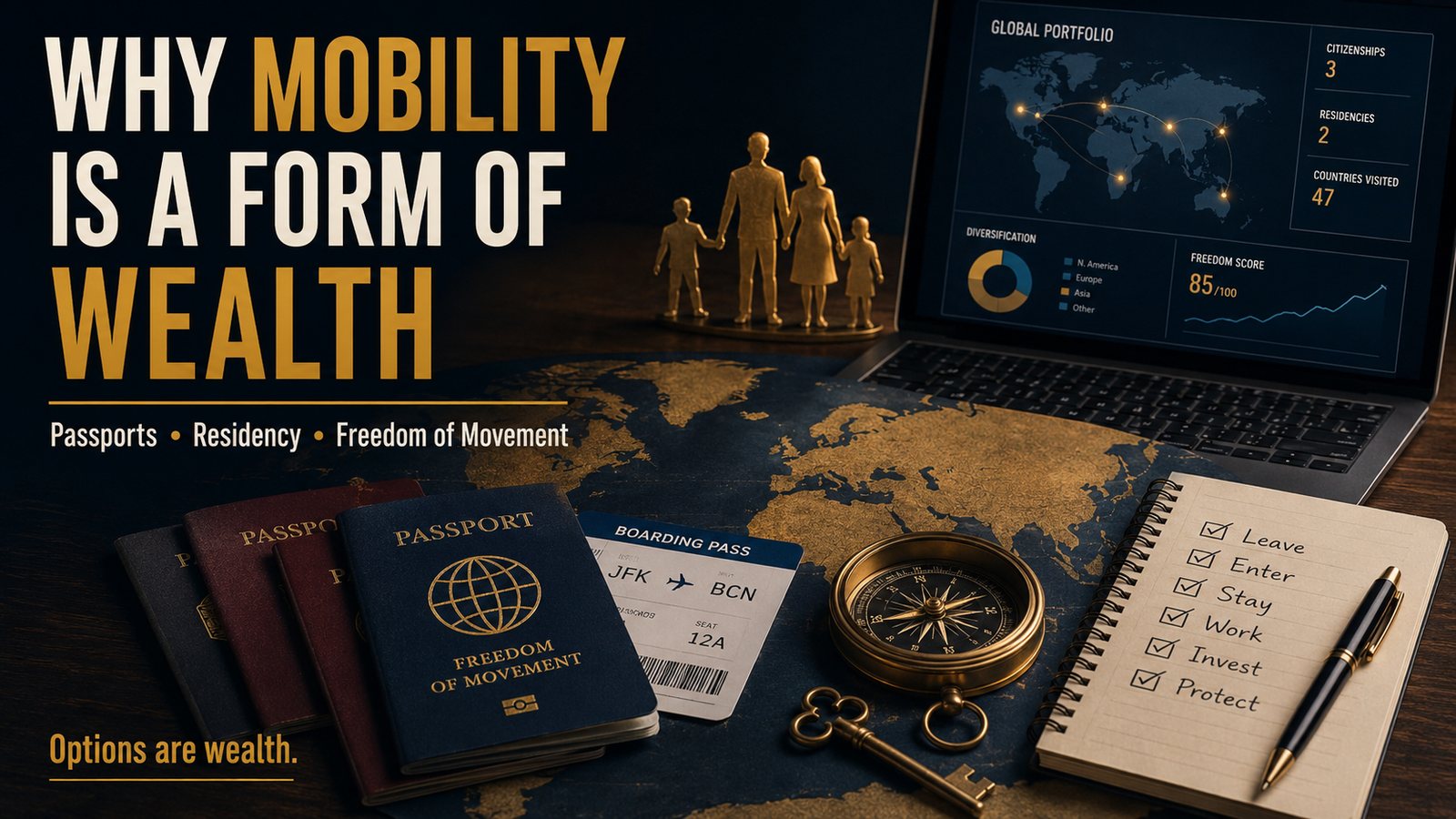
Why Mobility Is a Form of Wealth
Category: Geographic Arbitrage
Most people think of wealth as money.
Cash in the bank. Stocks in a portfolio. Real estate. Business equity. Gold. Bitcoin. Income streams. Assets that can be counted, priced and placed neatly on a balance sheet.
That view is useful.
But it is incomplete.
There is another kind of wealth that many people only understand after they lose it.
Mobility.
The ability to leave. The ability to enter. The ability to stay. The ability to work, invest, bank, protect your family, access healthcare, educate your children and build a life somewhere else if your current country stops working for you.
Mobility is not a luxury.
It is optionality.
And optionality is wealth.
A Passport Is Not Just a Travel Document
Most people treat their passport as something they use at the airport.
They think of it as a document for holidays, business trips or border control. It sits in a drawer until it is time to travel, then it disappears again until the next trip.
That is the ordinary view.
The globally minded investor sees something different.
A passport is a permission structure. It determines where you can go, how easily you can enter, how long you can stay, whether you can work, whether you can access certain systems, and how governments treat you at borders.
A strong passport can reduce friction.
A weak passport can create friction.
A second passport can create options.
And in an unstable world, options matter.
Mobility Changes Your Relationship With Government
A person who cannot leave is easy to control.
He may complain about taxes, regulation, education, healthcare, crime or bureaucracy, but if he has no practical alternative, the government does not need to take him seriously. He is a captive taxpayer. A fixed asset. A predictable source of revenue.
Mobility changes that relationship.
A person with a second residence, second passport, foreign bank account, internationally portable income or realistic relocation plan stands differently. He may still obey the law. He may still pay what he owes. He may still love his country.
But he is not trapped.
That changes everything.
Governments behave differently when productive people have options. Countries compete for capital, talent, entrepreneurs, retirees and investors. Some offer better tax systems. Some offer better residency. Some offer better safety. Some offer better lifestyle. Some offer better banking or asset protection.
The mobile person can compare.
The trapped person can only endure.
The Real Value of Optionality
Optionality is valuable because the future is uncertain.
You do not know what your country will look like ten years from now. You do not know how taxes will change. You do not know whether housing will remain affordable. You do not know whether schools will respect your values. You do not know whether healthcare will improve or decline. You do not know whether political tensions will calm down or intensify.
Most people respond to this uncertainty by hoping.
Investors should respond by planning.
Mobility is a form of insurance. Not the kind you buy from an insurance company, but the kind you build through structure. A second residence, second passport, foreign banking relationship or realistic relocation path gives you another door.
You may never need to walk through it.
But knowing it exists changes the way you live.
Mobility and Financial Independence
Financial independence is usually described as having enough assets to support your life without depending on a job.
That is a good definition.
But it misses geography.
If your assets are large enough to support your life only inside one country, under one tax system, with one healthcare structure and one cost of living assumption, your independence may be more fragile than it looks.
Mobility strengthens financial independence because it gives your portfolio more possible environments.
A €40,000 annual withdrawal may feel tight in one country and comfortable in another. A dividend portfolio may be heavily taxed in one jurisdiction and treated more gently in another. A family may struggle with housing costs in a major Western city but live with more margin in a lower-cost country.
Location changes the math.
Mobility allows you to use that fact.
It turns financial independence from a single-country calculation into a global strategy.
Visa-Free Travel Is Only One Part of the Story
Many passport rankings focus heavily on visa-free travel.
That matters. A passport that allows easy access to many countries is valuable. It reduces friction, saves time, and makes business and travel easier.
But visa-free travel is not the whole story.
A strong passport for tourism may not be the best passport for tax, dual citizenship, personal freedom or long-term flexibility. Some passports are excellent for travel but come from countries with heavy taxation, military obligations or increasing political control. Other passports may have fewer visa-free destinations but offer better tax treatment, easier dual citizenship or stronger personal autonomy.
For investors, the question is not simply:
“How many countries can I visit?”
The better question is:
“What does this citizenship do for my life, taxes, freedom, family and future?”
That is a more serious question.
The Five Dimensions of Passport Wealth
A passport should be judged through more than one lens.
1. Travel Mobility How many countries can you enter easily, and how much friction does the passport remove?
2. Tax Flexibility Does the country tax citizens based on citizenship, residence, source of income or some other system?
3. Dual Citizenship Can you legally hold another citizenship, or must you give up your original nationality?
4. Personal Freedom Does citizenship expose you to military service, surveillance, restrictions or loss of civil liberties?
5. Global Perception How is the passport viewed by banks, border officials, governments and international institutions?
This framework is important because a passport is not just about movement.
It is about how the world receives you.
Citizenship-Based Taxation: The Hidden Chain
One of the most important passport questions is taxation.
Some countries tax based on residence. If you leave and become tax resident elsewhere, your tax situation may change. Other countries may tax local-source income, foreign-source income, or remitted income depending on their system.
But a few countries tax citizens even when they live abroad.
That matters enormously.
A citizenship that follows you everywhere can become a hidden chain. You may leave the country physically, but the tax system travels with you. You may move abroad, build a business, invest internationally and raise your family elsewhere, but still face reporting duties, tax complexity or compliance burdens from a country you no longer live in.
This does not automatically mean such citizenship is worthless.
But it does mean the passport must be understood honestly.
A passport can give freedom of movement while reducing tax freedom.
That trade-off must be seen clearly.
Second Residence Comes Before Second Passport
Many people hear about second citizenship and immediately think of passports.
But for most families, second residence is the more practical first step.
A residence permit gives you the legal ability to stay in another country. It may allow you to rent or buy property, access healthcare, open bank accounts, spend more time there and eventually qualify for permanent residence or citizenship.
Second residence is often cheaper and easier than second citizenship.
It also allows you to test the country before making a larger commitment. You can learn whether the climate suits you, whether your family feels safe, whether healthcare works, whether schools or homeschooling options make sense, whether the community fits and whether daily life is actually livable.
A second passport is powerful.
But a second residence can be the first real door.
Mobility Protects Families
Mobility matters even more when you have a family.
A single person can tolerate more risk, inconvenience and improvisation. A family cannot. Children need stability, safety, education, healthcare, community and routines. A spouse must also be able to live well, not merely survive the strategy.
That is why mobility planning should not be treated as a game for restless nomads.
For families, mobility is protection.
It gives parents the ability to choose a better environment if schools become hostile to their values, if safety declines, if healthcare deteriorates, if taxes become punitive or if society becomes too unstable.
The goal is not to drag children from country to country.
The goal is to make sure the family has somewhere to go if staying becomes unwise.
A family with options is harder to corner.
Mobility and Asset Protection
Wealth is not protected only by legal documents.
It is also protected by jurisdiction.
If all your assets, income, bank accounts, property, business interests and residency rights sit inside one country, then your financial life is concentrated. One government, one court system, one banking system, one tax authority and one political culture hold too much power over your future.
Mobility helps reduce that concentration.
A foreign bank account, foreign brokerage relationship, second residence, international company structure, property abroad or second citizenship can all form part of a broader asset-protection strategy.
This does not mean hiding assets.
It means lawful diversification.
A serious investor would not put 100% of his portfolio into one stock. Yet many people put 100% of their life under one government.
That is not prudence.
It is habit.
Mobility Does Not Mean Constant Movement
There is a shallow version of mobility that looks like endless travel.
Airports. Cafes. Suitcases. Beaches. Instagram photos. No roots. No responsibility.
That may appeal to some people for a season, but it is not the FireByMike vision.
The better version of mobility is not constant movement.
It is structured freedom.
You can have a home base and still have options. You can raise children and still think internationally. You can love stability and still refuse dependence on one jurisdiction. You can be rooted without being trapped.
Mobility should serve order, not chaos.
A second residence, second passport or Plan B country should make your life more stable, not more scattered.
The Cost of Waiting Too Long
Many people wait until a crisis before thinking about mobility.
That is usually too late.
During crises, governments tighten rules. Borders close. Residency programs become more expensive. Banks become cautious. Immigration offices slow down. Property prices in desirable places rise. Everyone wants the same exit at the same time.
Mobility is easiest to build when you do not yet need it.
That is the paradox.
When life is calm, people postpone. When life becomes unstable, they rush. But the people who prepared during calm periods have the advantage.
They already know where to go.
They already have documents.
They already understand the rules.
They already tested the country.
They are not guessing under pressure.
How to Build Mobility Step by Step
Mobility does not have to begin with an expensive passport program.
It can begin simply.
FireByMike Mobility Ladder
1. Portable Income Build income that is not fully tied to one local employer or city.
2. International Banking Awareness Learn how banking, brokerage access and currency exposure work across borders.
3. Country Research Compare countries based on taxes, safety, healthcare, schooling, residency and cost of living.
4. Test Trips Visit possible bases for longer than a holiday, preferably during the less attractive season.
5. Second Residence Obtain legal permission to stay in a country that fits your strategy.
6. Asset Diversification Consider whether some assets, accounts or structures should exist outside your home country.
7. Permanent Residence or Citizenship Only after testing the country should you consider deeper commitments.
8. Exit Map Know where you would go if your main country changed suddenly.
This ladder is slower than the fantasy version.
That is why it works better.
The Best Passport Is Not Always the Best Life
A country can have a powerful passport and still be a poor fit.
Maybe it gives excellent travel access but has high taxes. Maybe it has strong global perception but allows little personal freedom. Maybe it permits dual citizenship but is too expensive to live in. Maybe it offers strong civil liberties but weak tax flexibility.
There is no universal best passport.
There is only the passport that solves your problem.
For one person, that may mean visa-free travel. For another, tax flexibility. For another, the ability to hold dual citizenship. For another, a safe European base. For another, a backup in Latin America. For another, a citizenship that can be passed to children.
The serious investor does not ask:
“What is the best passport?”
He asks:
“Best for what?”
Mobility and the Children
One of the most overlooked benefits of mobility is what it can give to children.
A second citizenship or residence can expand their future choices. It may open access to universities, job markets, healthcare systems, safer countries, different cultures or lower-cost living. It may give them a way out if their birth country becomes more difficult.
Parents often think of inheritance only in financial terms.
But mobility can also be inherited.
A passport, residence right, language skill, international mindset or familiarity with another country can become a form of family capital.
Your children may not use it immediately.
But one day they may be grateful that the door exists.
Common Mistakes
Mobility planning goes wrong when people confuse symbols with substance.
A second passport is not automatically useful if it comes from a country you would never visit, live in or use. A residence permit is not useful if the country is unsuitable for your family. A low-tax jurisdiction is not useful if you cannot access banking or healthcare. A beautiful place is not useful if the schools, safety or legal system do not work.
Another mistake is moving too fast.
People see a country praised online and assume it must be right. But a YouTube video is not due diligence. A vacation is not residency research. A tax chart is not a life plan.
Good mobility planning requires patience.
Visit. Test. Compare. Ask. Read. Consult. Calculate. Think.
Then act.
The FireByMike Mobility Scorecard
Before treating a country as part of your Plan B, ask these questions.
FireByMike Mobility Scorecard
1. Can I legally enter and stay? Visa-free travel is not the same as residence.
2. Can I become resident if needed? Understand the route, cost, renewal rules and physical presence requirements.
3. Can my family live there safely? Safety, healthcare, schooling and community matter.
4. Can I bank and invest there? A country may be livable but financially awkward.
5. What are the tax consequences? Understand both the new country and the country you may be leaving.
6. Can I hold dual citizenship? Some countries allow it freely. Others restrict it.
7. What happens if rules change? A Plan B should not depend on one fragile door.
8. Can my children benefit from this? Think generationally, not only personally.
A good mobility plan should make your life more resilient.
Not more complicated for the sake of complexity.
The Bottom Line
Mobility is a form of wealth because it gives you options.
Money matters. Investments matter. Income matters. But if your whole life is trapped inside one jurisdiction, your wealth is more vulnerable than it appears.
A passport can open doors. A second residence can create a legal base. A second citizenship can give long-term optionality. International banking and asset diversification can reduce concentration risk. A tested relocation plan can protect your family from political, tax, healthcare or social decline.
The goal is not to hate your home country.
The goal is to stop depending on it completely.
A free person has choices.
A prepared family has exits.
A serious investor understands that jurisdiction is part of the balance sheet.
That is why mobility is wealth.
Not because it lets you travel more.
Because it helps you remain free when the rules change.