
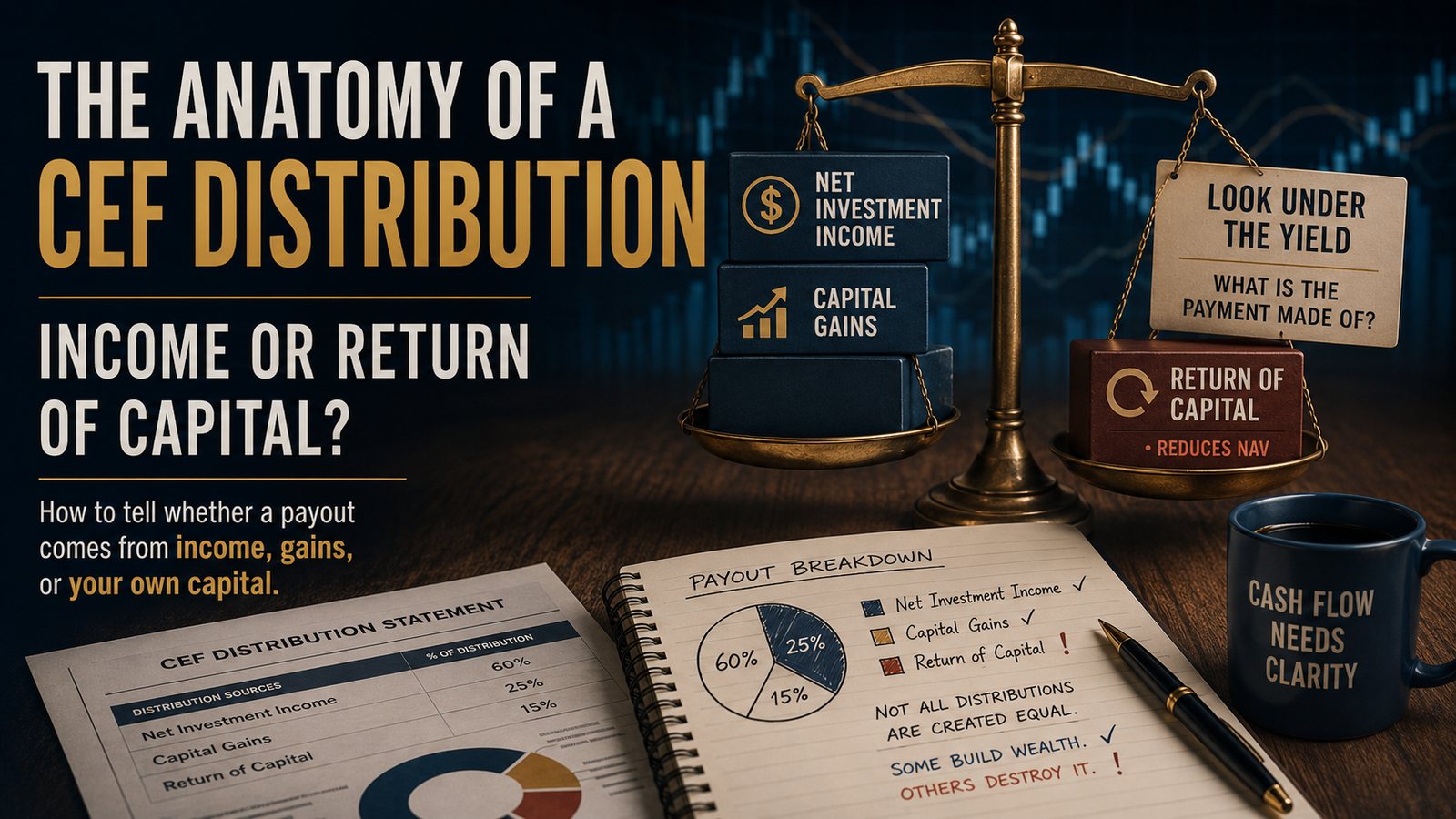
The Anatomy of a CEF Distribution: Income or Return of Capital?
It may be monthly. It may be quarterly. It may be small at first. But psychologically, it feels different from a stock price moving up on a screen. A distribution feels real. It feels like the portfolio is finally doing…
Every income investor loves the same little moment.
The payment arrives.
It may be monthly. It may be quarterly. It may be small at first. But psychologically, it feels different from a stock price moving up on a screen. A distribution feels real. It feels like the portfolio is finally doing something useful.
Money came in.
That is why income investing is so emotionally powerful. A rising share price feels theoretical until you sell. A distribution feels practical because it lands in the account and can be used for groceries, bills, reinvestment, or freedom.
But with Closed-End Funds, there is a quiet question every investor must learn to ask:
Where did that money actually come from?
Because not every distribution is the same. Some distributions come from interest and dividends. Some come from realized capital gains. Some come from Return of Capital. And sometimes, a distribution that looks like income is partly your own money being handed back to you.
That does not always make it bad.
But it does mean you need to understand the anatomy of the payment.
The Word “Yield” Can Be Misleading
A CEF showing a 9% distribution rate looks simple. You invest. The fund pays. You collect. But the word “yield” can hide several different realities.
A fund may pay 9% because the assets genuinely generate strong income. It may pay 9% because the fund has realized gains. It may pay 9% because it uses leverage. Or it may pay 9% because it is returning part of your own capital.
The market screen usually shows the number. It does not always show the story.
That is why the income investor must slow down before celebrating a high distribution.
The Three Main Sources of a CEF Distribution
A CEF distribution usually comes from three broad sources.
The first source is net investment income. This is the cleanest and easiest to understand. Bonds pay interest. Preferred stocks pay dividends. Loans pay interest. Dividend stocks pay dividends. The fund collects that cash, pays expenses, and distributes the remaining income to investors.
This is the kind of income most people imagine when they buy an income fund.
The second source is realized capital gains. If the fund sells an investment for more than it paid, that gain may be distributed to shareholders. This can be perfectly legitimate, especially in equity funds, option-income funds, or funds that actively manage positions over time.
The third source is Return of Capital, usually called ROC.
This is where many investors become confused.
Return of Capital means the fund is distributing money that is not currently classified as net investment income or realized capital gains. In plain English, part of the payment may be a return of the investor’s own capital.
But ROC is not always bad.
That is the part many people miss.
Return of Capital: The Phrase That Scares Investors
The phrase “Return of Capital” sounds terrible.
It sounds like the fund is slowly sending your own money back to you while pretending it is income. Sometimes that is exactly what is happening. But not always.
The problem is that accounting language and economic reality do not always line up neatly. A fund may distribute cash in a way that is classified as ROC for tax or accounting purposes, even though the fund’s economic strategy is not necessarily destructive.
This is common in certain option-income funds, real estate-related funds, infrastructure funds, and other strategies where the timing and classification of cash flows may not match the simple idea of interest or dividends.
So the question is not:
“Does this fund have ROC?”
The better question is:
“Is this ROC destructive?”
That one word makes all the difference.
Good ROC and Bad ROC
Good ROC can be part of a normal fund strategy. It may reflect tax classification, unrealized gains, option-writing strategies, depreciation, or other accounting realities. In these cases, the fund may still be preserving its long-term asset base while distributing cash to shareholders.
Bad ROC is different. Bad ROC happens when a fund is not earning enough, not realizing enough gains, and is slowly handing investors their own capital back to maintain an attractive-looking payout.
That kind of ROC can quietly erode NAV.
The investor feels paid. The account receives cash. The distribution looks generous. But underneath, the fund may be shrinking.
That is the dangerous version.
The NAV Test
One of the simplest ways to think about a CEF distribution is to look at NAV over time.
If a fund pays a high distribution and NAV remains reasonably stable across a full market cycle, the distribution may be more sustainable. That does not prove safety, but it suggests that the fund is not simply eating itself.
If a fund pays a high distribution while NAV steadily declines year after year, the income may be less impressive than it looks. The fund may be paying shareholders while gradually weakening the asset base that supports future payments.
Imagine two funds.
Fund A pays 8% and its NAV remains reasonably stable over time.
Fund B pays 12% but its NAV keeps falling.
At first glance, Fund B looks better. It pays more. It feels more productive. It makes the brokerage account look busier. But if the NAV is being slowly destroyed, the investor may not be receiving true income. He may simply be receiving his own capital in monthly installments.
That is not income investing.
That is liquidation with nicer packaging.
Why Funds Avoid Cutting Distributions
Distribution cuts are painful.
Investors buy CEFs for income. When a fund cuts its payout, shareholders often sell. The market price can fall. The discount can widen. The fund’s reputation can suffer.
Because of that, some funds try very hard to maintain their distributions. Sometimes that is responsible. A fund may smooth distributions through changing markets, using reserves, realized gains or managed distribution policies.
But sometimes the desire to maintain the payout becomes dangerous. The fund keeps paying more than it can truly support because cutting would upset investors.
This is where the yield trap begins.
A fund does not have to announce that it is weakening. It can simply keep paying until the numbers no longer work.
Managed Distribution Policies
Some CEFs use managed distribution policies. This means the fund targets a regular payout according to a stated policy. For income investors, that can be attractive because it creates predictable cash flow.
But predictability is not the same as sustainability.
A managed distribution may include income, gains and Return of Capital. The policy may smooth the ride, but it does not remove the need to understand what supports the payment.
The investor should ask a few simple questions. Is the distribution supported by net investment income? Is it supported by realized gains? Is ROC present? If ROC is present, is NAV stable or shrinking? Has the fund repeatedly cut the payout in the past?
Those questions are boring.
That is why they matter.
The Section 19a Notice
CEF investors may see a Section 19a notice when a fund estimates that part of its distribution comes from sources other than net investment income.
Many investors panic when they see ROC in such a notice. They should not panic automatically. A Section 19a notice is not always the final tax classification. It is usually an estimate, and the final character of distributions is often determined after year-end.
Still, it is useful information. If a fund repeatedly reports large amounts of ROC, the investor should investigate. The question is not whether ROC appears once. The question is whether the fund’s long-term NAV and distribution history show a healthy or destructive pattern.
Think of it like a smoke alarm.
It does not always mean the house is burning.
But you should still look.
Distribution Rate Versus Total Return
A common mistake is to look at a CEF’s distribution rate without looking at total return.
A fund may pay 10% per year but lose value over time. Another fund may pay 7% and preserve or grow NAV more effectively. The first one may feel better in the short term because it pays more cash. The second one may be healthier over the long term.
Income matters.
But income without preservation of capital can become a slow leak.
This is why serious income investors look at both cash flow and asset value. A CEF does not have to grow like a technology stock. That is not the purpose. But it should not quietly destroy its own foundation just to keep the distribution looking attractive.
A high distribution is not automatically a high return.
Sometimes it is just a loud withdrawal.
A Simple Distribution Checklist
Before buying a high-yield CEF, ask five questions.
First, what is the distribution rate? Not because the highest number wins, but because a high number requires explanation.
Second, what is the distribution made of? Look for net investment income, realized gains and Return of Capital.
Third, how has NAV behaved over time? A stable or growing NAV tells a very different story from a steadily declining NAV.
Fourth, has the fund cut its distribution before? A history of repeated cuts suggests the payout may have been too ambitious.
Fifth, how does the fund generate cash? A bond fund, covered-call fund, equity fund and real estate fund can all pay distributions, but the source of those distributions is not the same.
The Order Matters Do not start with the yield. Start with the source of the distribution. Then check NAV. Then check the history. The yield comes last.
What to Avoid
Be careful with CEFs that combine several warning signs at once: very high distribution rates, persistent NAV decline, repeated distribution cuts, large unexplained ROC, high leverage, and poor long-term total return.
Any one of these may be explainable. Together, they deserve caution.
The danger is not that the fund pays a high distribution. The danger is that the investor stops asking how the fund pays it.
That is how yield traps work.
They do not usually look dangerous at first. They look generous.
When ROC Can Be Acceptable
Return of Capital can be acceptable when the fund’s strategy naturally produces it, when NAV remains reasonably stable, and when the distribution policy is clearly explained. It can also be useful from a tax perspective in some jurisdictions, although tax treatment depends heavily on the investor’s country and personal situation.
The point is not to fear ROC.
The point is to understand it.
A serious income investor does not reject every fund with ROC. But he also does not ignore it. He reads the notices, checks the NAV, studies the distribution history and asks whether the fund is preserving the engine that produces future income.
That is the difference between income investing and yield chasing.
The Bottom Line
A CEF distribution is not one thing.
It is a package.
Inside that package may be interest, dividends, realized gains, option income, accounting classifications and Return of Capital. Some of it may be healthy. Some of it may be temporary. Some of it may be destructive.
The income investor’s job is not to fear every high distribution. The job is to understand it.
Because the danger in CEF investing is not that a fund pays income. The danger is that an investor mistakes every payment for earned income.
A monthly distribution can be a sign of strength.
It can also be a slow return of your own money.
The difference is not always visible in the headline yield. You have to look under the surface.
And that is where real income investing begins.