
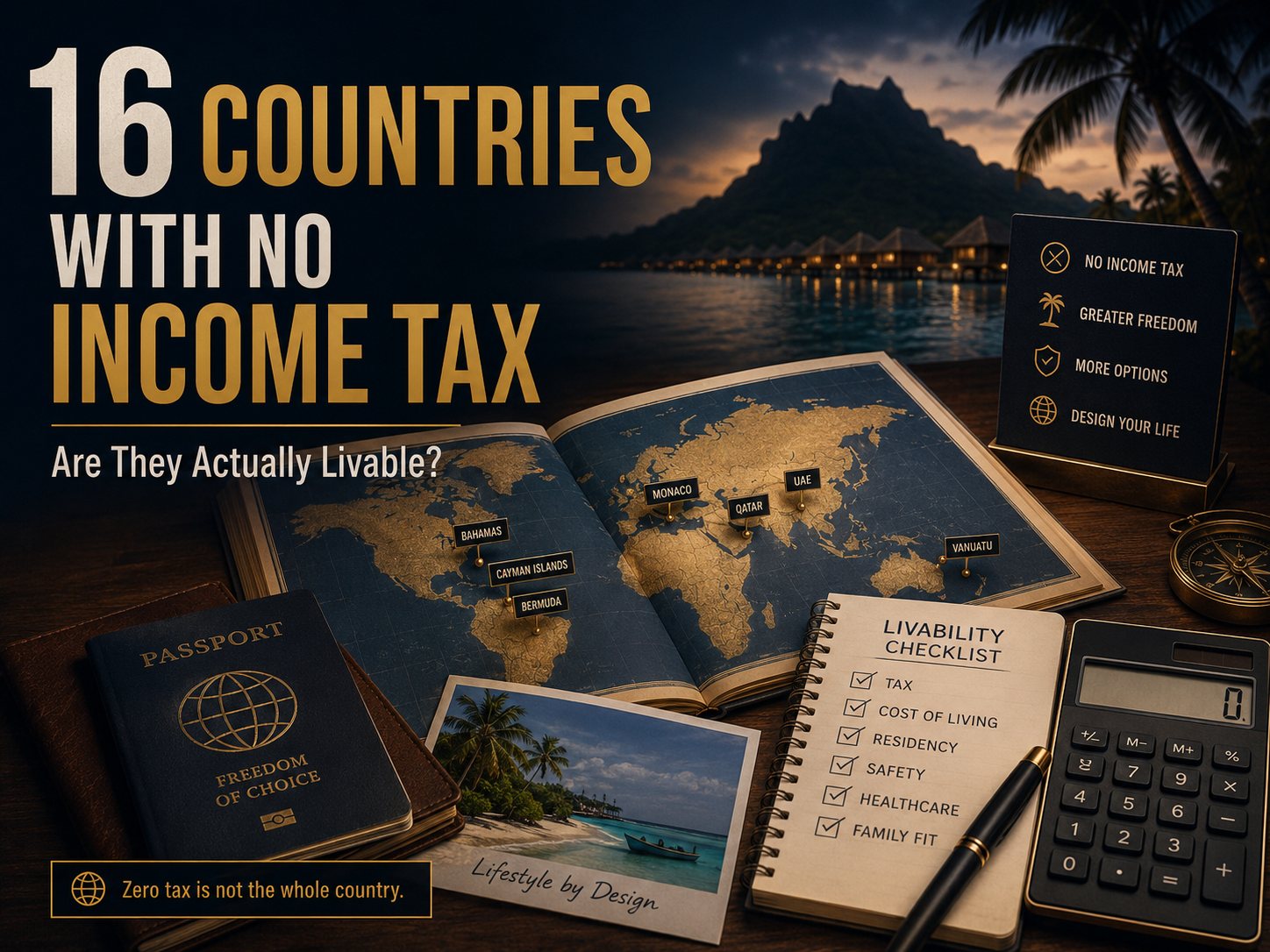
16 Countries with No Income Tax: Are They Actually Livable?
There are few phrases more powerful to an overtaxed investor than this one:
There are few phrases more powerful to an overtaxed investor than this one:
“No income tax.”
It sounds almost unreal. No tax on your salary. No tax on your business income. No tax on your personal earnings. After years of watching governments take a large share of every raise, bonus, dividend or business success, the idea feels like a financial sunrise.
Keep what you earn.
Build faster.
Stop feeding a system that punishes productivity.
That is the emotional appeal.
But serious investors should slow down. A country with no personal income tax is not automatically a good place to live, invest, raise children or build a long-term base. Zero tax can be valuable, but it is only one part of a much larger structure.
A no-income-tax country can still be expensive, restrictive, difficult to access, culturally unsuitable, weak on healthcare, risky for families or dependent on rules that may change.
Tax matters.
But it is not the whole country.
What “No Income Tax” Actually Means
A no-income-tax country generally does not impose personal income tax on individuals. That means employment income, business income or certain personal earnings may not be taxed in the way they are in high-tax countries.
But this does not mean the country has no taxes at all.
Governments still need money. They may collect it through VAT, customs duties, corporate taxes, property fees, tourism taxes, payroll charges, stamp duties, import duties, residency fees or revenue from natural resources. Gulf countries often rely heavily on oil and gas. Island jurisdictions may rely on tourism, financial services, import duties or government fees.
So “no income tax” does not mean “free country.”
It means the government has chosen not to tax personal income directly.
That distinction matters.
Why No-Income-Tax Countries Exist
Countries usually avoid personal income tax for one of four reasons.
Some are resource-rich. Gulf states such as the UAE, Qatar, Kuwait, Bahrain and Oman have historically relied on oil and gas revenue. That allowed them to fund government activity without building a Western-style personal income tax system.
Some are financial centres. Places such as the Cayman Islands, Bermuda and Monaco attract capital, companies, funds, insurers, wealthy residents and international business. Their tax model is part of their economic positioning.
Some are tourism-driven islands. The Bahamas, Maldives and similar jurisdictions may rely on tourism, import duties, hospitality and residency-related spending rather than personal income tax.
Some are small jurisdictions that compete through simplicity. A small country cannot always compete with the United States, Germany or France on scale. It can compete by being easier, lighter and more attractive to mobile capital.
That is the key idea.
Tax policy is often a form of competition.
Countries compete for people, capital and businesses just as companies compete for customers.
The Common List of No-Income-Tax Countries
Lists differ slightly depending on definitions, timing and whether dependent territories are included. But the countries and jurisdictions most often discussed in the no-personal-income-tax category include:
Commonly Listed No-Personal-Income-Tax Jurisdictions
The Bahamas Bahrain Bermuda Brunei Cayman Islands Kuwait Maldives Monaco Nauru Oman Qatar Saint Kitts and Nevis Saudi Arabia United Arab Emirates Vanuatu Western Sahara
This list should not be treated as legal advice. Tax systems change, and residency status matters. Some countries may have no personal income tax but still apply social security charges, corporate taxes, VAT, municipal taxes, property taxes or special rules for certain income types.
The investor’s question should not be:
“Where is there no income tax?”
The better question is:
“Where can I legally become tax resident, live well, protect my assets and build a life without creating new problems?”
That is a very different question.
The FireByMike Livability Test
A no-income-tax country must pass more than a tax test.
It must pass a life test.
1. Residency Access Can you legally live there, renew your status and possibly build toward permanent residence?
2. Actual Cost of Living Does the tax saving survive the rent, school fees, healthcare, transport and imported goods?
3. Safety and Stability Can your family live calmly and plan long term?
4. Healthcare Is good medical care available without needing to fly out for every serious issue?
5. Banking and Investment Access Can you bank, invest, receive income and manage assets efficiently?
6. Family Fit Does the country work for your spouse, children, schooling, community and daily rhythm?
7. Rule Stability Is the tax regime stable, or does it depend on political, oil, tourism or foreign-capital cycles?
8. Exit Options If the country changes, where do you go next?
This framework keeps the investor from making the classic mistake: treating a tax rate as if it were a complete life strategy.
The Gulf Model: Zero Tax, High Infrastructure, Cultural Trade-Offs
The Gulf countries are often the first places people think of when they hear “no income tax.”
The UAE, Qatar, Kuwait, Bahrain, Oman and Saudi Arabia all offer versions of the low- or no-personal-income-tax model. For business owners, executives and globally mobile professionals, this can be attractive. The infrastructure can be strong, the airports excellent, the banking sophisticated and the business environment internationally connected.
The UAE, especially Dubai and Abu Dhabi, has become the poster child for this model. It offers modern infrastructure, international schools, luxury housing, global connectivity and a major business ecosystem. It is not surprising that many entrepreneurs, investors and high-income professionals consider it.
But the Gulf model is not for everyone.
Costs can be high. Summer heat can be intense. Cultural and legal differences matter. Long-term citizenship may be difficult or unrealistic. Family life may work beautifully for some and feel artificial for others. The lifestyle can be impressive, but also expensive.
In other words, the Gulf can be excellent.
But it is not automatically easy.
The Caribbean Model: Beautiful, Tax-Friendly, Often Expensive
The Caribbean no-tax jurisdictions offer a different promise.
The Bahamas, Cayman Islands, Bermuda and Saint Kitts and Nevis are often associated with beaches, finance, offshore structures, tourism and wealth. The attraction is obvious: warm weather, English-speaking environments in several cases, established international networks and tax-friendly systems.
The Cayman Islands are a clear example. The Beach Index ranks the Cayman Islands highly because of their combination of natural beauty and attractive tax-free regime; it also notes that residency is possible but expensive, with real estate routes requiring very significant investment.
The Bahamas offer another version of the same story. They are a well-established tax haven with very few taxes and beautiful islands, but permanent residence generally requires substantial real estate investment.
This is the Caribbean trade-off.
The tax situation may be attractive, but the cost of entry, housing, imported goods, insurance and private services may be high. For wealthy investors, that may be acceptable. For ordinary FIRE families, it may destroy the savings benefit.
A zero-tax island is not automatically a low-cost island.
Sometimes it is the opposite.
Monaco: No Income Tax, But Not for Normal Budgets
Monaco may be the most glamorous no-income-tax jurisdiction in the world.
It is safe, prestigious, beautiful and financially sophisticated. It also sits inside Europe, with access to the French Riviera and a long tradition of attracting wealthy residents.
But Monaco is not a geo-arbitrage destination in the normal sense.
It is not where you go to lower your monthly budget. It is where very wealthy people go when the tax saving, safety, prestige and lifestyle justify the extraordinary cost. Housing is extremely expensive. Entry is not designed for the average remote worker or middle-class family.
For the right person, Monaco can make sense.
For most people, it is more useful as a concept than as a realistic plan.
The lesson is simple: a country can be tax-free and still completely outside your economic reality.
The Remote Islands: Vanuatu, Maldives and Nauru
Some no-income-tax countries look attractive on a list but become more complicated when you imagine daily life.
Vanuatu, Maldives and Nauru may have tax advantages, but geography matters. Distance, infrastructure, healthcare, flights, education, imports, banking and long-term community can become real concerns.
A small island can be wonderful for a visit, a passport strategy or a specific legal structure.
But living there full time is a different question.
This is especially important for families. Children need education, community, healthcare, activities and stability. Adults need work rhythm, reliable internet, medical access, banking, transport and social life.
A remote island may offer a low tax burden but a high practical burden.
That does not make it bad.
It means it must be used for the right purpose.
Brunei and the Reality Problem
Brunei is another example of why no-income-tax lists can mislead.
On paper, it is tax attractive. It is wealthy because of oil and gas. It does not need a normal personal income tax system in the same way as many Western countries.
But for many expats, Brunei may not be a practical long-term base. Residency, culture, social life, legal environment, family fit and lifestyle may not suit most readers. A country can be financially attractive in one column and unsuitable in the rest of the spreadsheet.
That is why the FireByMike approach is not to worship tax rates.
The goal is not to win a theoretical tax contest.
The goal is to design a life that works.
No Income Tax vs Low Tax
This may be the most important point in the whole article:
A low-tax country may be better than a no-tax country.
Why?
Because low tax plus livability can beat zero tax plus friction.
A country with a reasonable territorial system, special tax regime, non-dom structure, flat tax or low effective rate may offer a better total package than a pure no-income-tax jurisdiction. It may have better healthcare, easier residency, stronger schools, more normal housing costs, better infrastructure and a more comfortable family environment.
This is why countries like Panama, Georgia, Paraguay, Cyprus, Malta, Greece, Portugal, Malaysia or Thailand often appear in geo-arbitrage conversations even when they are not pure no-income-tax countries.
The best strategy may not be zero.
It may be reasonable.
The Hidden Costs of No Income Tax
Zero personal income tax can hide several costs.
The first is residency cost. Some jurisdictions require investment, property purchase, business formation, deposits, local fees or proof of substantial income.
The second is lifestyle cost. Rent, imported food, private schools, international healthcare, flights and insurance can erase the tax saving.
The third is opportunity cost. A country may be tax-friendly but less useful for networking, business building, education or professional growth.
The fourth is exit cost. If you structure your life around one jurisdiction and the rules change, leaving may be expensive or disruptive.
The fifth is tax complexity. Your home country may still tax you. This is especially relevant for citizens of countries with citizenship-based taxation, but it can also affect people who fail to break tax residency properly.
A no-tax country does not solve tax planning by itself.
It only creates a possible destination.
Who Benefits Most from No-Income-Tax Countries?
No-income-tax jurisdictions usually benefit three types of people most.
The first is the high-income professional or entrepreneur who can legally move tax residency and continue earning from abroad. If income remains strong and personal income tax falls sharply, the savings can be enormous.
The second is the investor or business owner with significant international income, especially if the jurisdiction offers strong banking, legal reliability and asset protection.
The third is the high-net-worth family that values safety, privacy, lifestyle and tax efficiency more than low living costs.
The typical middle-class FIRE seeker needs to be more careful. A no-income-tax country may sound perfect, but if the cost of living is too high, it may slow down financial independence rather than accelerate it.
For ordinary investors, the best geo-arbitrage destination may be a lower-cost, reasonably taxed country rather than an expensive tax haven.
Who Should Be Careful?
Several groups should be especially cautious.
Families with school-age children should not choose a country based on tax alone. International schools can be expensive, homeschooling rules vary, and children need community.
People with medical needs should study healthcare deeply. Some no-tax countries have excellent private care; others require travel for serious treatment.
Remote workers with modest income should calculate total costs carefully. Saving 20% in tax is not useful if rent, flights, food and insurance rise by 40%.
Investors from high-tax countries should get professional advice before assuming they can simply leave. Tax residency, exit taxes, corporate residence, controlled foreign company rules and social security obligations can all matter.
A tax move done badly can become very expensive.
A Practical Ranking by Use Case
Instead of ranking countries by tax rate, rank them by purpose.
FireByMike Use-Case Map
Best for high-income professionals: UAE, Qatar, Bahrain
Best for wealthy families seeking prestige and safety: Monaco, Cayman Islands, Bermuda
Best for offshore finance and asset protection: Cayman Islands, Bermuda, Bahamas
Best for Caribbean lifestyle and citizenship strategy: Saint Kitts and Nevis, Bahamas, Cayman Islands
Best for tax appeal but difficult daily life: Brunei, Nauru, Western Sahara
Best to compare against low-tax alternatives: UAE, Bahamas, Panama, Cyprus, Greece, Malta, Paraguay
This is not a final recommendation. It is a better starting point than “sort by tax rate.”
The Better Question: Are They Actually Livable?
This is where the article’s title matters.
Are no-income-tax countries actually livable?
Some are, for the right person. The UAE can be very livable for high-income professionals and entrepreneurs. Monaco can be extraordinary for the very wealthy. Cayman Islands and Bermuda can work for people with sufficient capital. Bahrain may suit some expats. The Bahamas can be attractive for those who can afford the entry and lifestyle costs.
But many no-income-tax countries are not broadly livable for the average investor.
They may be too expensive, too remote, too restrictive, too hot, too small, too dependent on one industry or too difficult for families.
That does not make the tax benefit fake.
It means the tax benefit must be placed inside reality.
The Bottom Line
No-income-tax countries are attractive for a reason.
They allow productive people to imagine a different relationship with government. Instead of losing a large portion of income every year, the investor can keep more, save more, invest more and potentially reach financial independence faster.
But zero tax is not a complete strategy.
A country must also be safe, livable, legally accessible, medically reliable, financially functional and suitable for your family. If it fails those tests, the tax benefit may not be enough.
The best country is not always the one with the lowest tax rate.
It is the one where your money, family and future work best after all costs are counted.
That is the FireByMike rule.
Do not chase tax-free living.
Build a free life.