The Freedom Index Explained: What Makes a Country Truly Free?
They usually begin with the country they were taught to admire. The flag. The anthem. The constitution. The history books. The national stories about liberty, democracy, opportunity and rights.
Most people think they know what a free country is.
They usually begin with the country they were taught to admire. The flag. The anthem. The constitution. The history books. The national stories about liberty, democracy, opportunity and rights.
But reputation is not the same as reality.
A country can speak beautifully about freedom while making ordinary life harder every year. It can praise entrepreneurship while punishing success. It can defend property rights in speeches while quietly weakening them through taxes, regulation and inflation. It can call itself democratic while making families feel increasingly powerless over education, healthcare, speech, privacy and daily life.
Freedom is not a label.
It is a lived condition.
That is why a serious investor, entrepreneur or globally minded family should ask a better question:
What actually makes a country free?
Freedom Is More Than Politics
The mistake is to treat freedom as a purely political idea.
Politics matters. Rule of law matters. Human rights matter. Free speech matters. But if a country protects speech while taxing productive families into exhaustion, is that enough? If a country has elections but makes it nearly impossible to build wealth, educate your children freely or protect your assets, is that truly freedom?
The answer is not simple.
Freedom has layers.
There is financial freedom. There is legal freedom. There is personal freedom. There is family freedom. There is freedom of movement. There is freedom from fear. There is the freedom that comes from high-quality healthcare, reliable infrastructure and social stability.
A country that scores well in one area may fail in another.
That is why freedom must be measured as a structure, not as a slogan.
The Five Parts of Practical Freedom
A useful freedom framework needs more than one number.
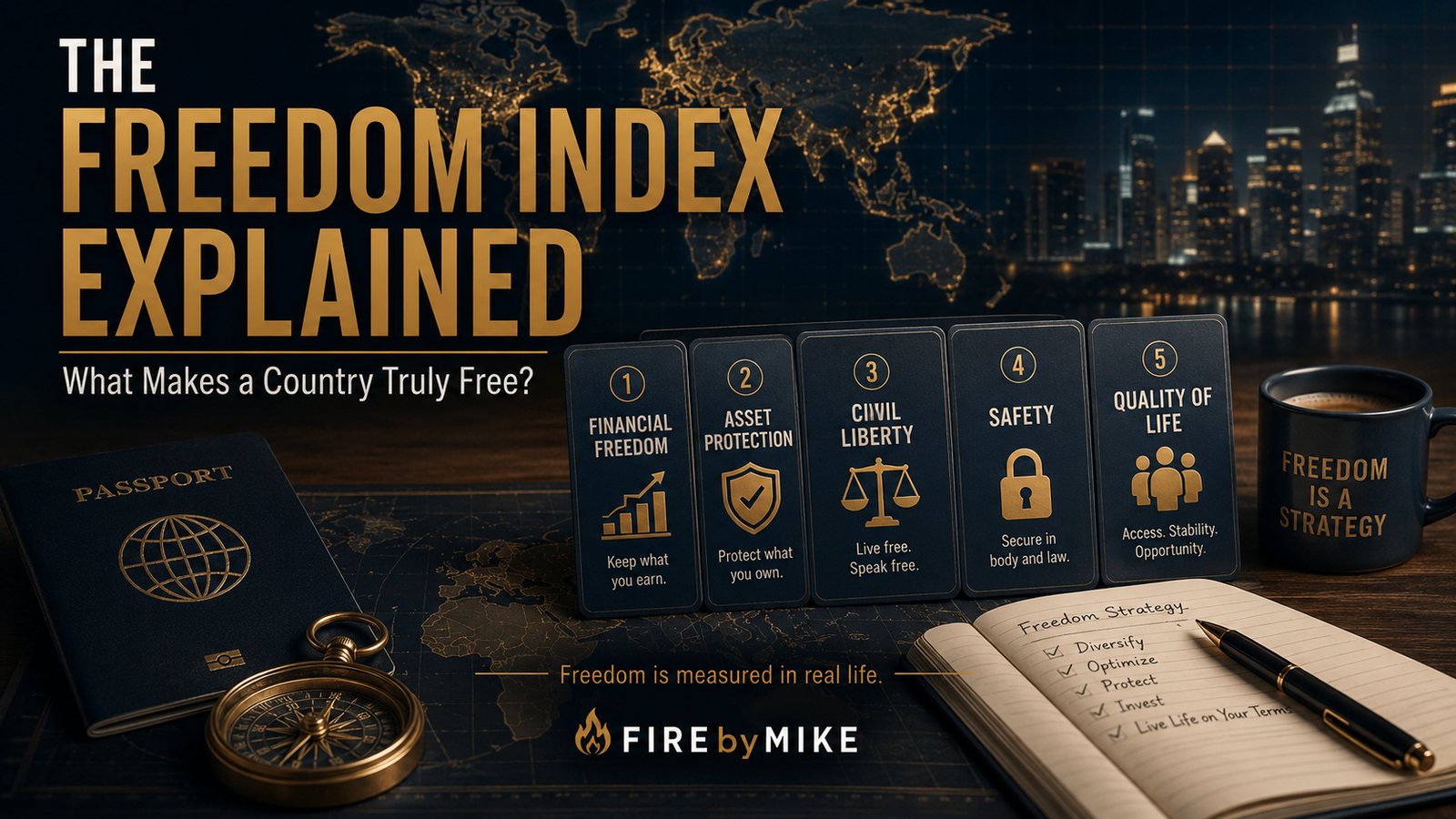
The Nomad Capitalist Freedom Index ranks countries by five broad factors: financial freedom, asset protection, human rights, safety and quality of life. The weighting is not equal. Financial freedom receives the highest weight, followed by asset protection, human rights, safety and quality of life.
That is a helpful starting point because it recognizes something most political conversations miss: freedom is not only about rights on paper. It is also about whether your money, family and future can function in real life.
For FireByMike readers, I would frame it this way:
1. Financial Freedom Can you earn, invest, save, bank and move capital without excessive friction?
2. Asset Protection Can you protect property, savings, business interests and wealth from arbitrary interference?
3. Human Rights and Civil Liberty Are speech, movement, family autonomy, conscience and rule of law respected in practice?
4. Safety Can your family live without constant concern about crime, instability or disorder?
5. Quality of Life Are healthcare, education, infrastructure, environment and daily life good enough to make freedom livable?
This framework prevents a common error: falling in love with one feature of a country while ignoring the rest.
A country can be tax-friendly but unsafe. Safe but expensive. Beautiful but bureaucratic. Wealthy but intrusive. Cheap but unstable. Politically free but financially hostile.
True freedom is the balance.
Financial Freedom: Can You Build?
Financial freedom comes first because wealth creation requires room.
A person who cannot keep much of what he earns cannot easily become independent. A business owner who is buried in regulation cannot focus on serving customers. An investor who faces punitive capital taxes, wealth taxes or constant reporting friction may find that compounding becomes much harder than it should be.
Financial freedom is not only about low income tax.
It includes the whole economic environment. Can you open bank accounts? Can you move capital? Can you invest internationally? Are capital gains treated reasonably? Are successful people respected or targeted? Are the rules predictable? Can you own property? Can you build a business without being treated as a suspect?
A country with high income, high tax and high bureaucracy may still have a strong economy, but that does not automatically make it a free place for builders.
The productive person needs more than opportunity.
He needs room to keep the fruit of his work.
Asset Protection: Can You Keep What You Build?
Building wealth is only half the story.
The second question is whether you can keep it.
Asset protection means that property rights, legal structures, banking systems and courts are reliable enough to protect what families and entrepreneurs create. It means the state cannot easily change the rules, seize assets, punish unpopular groups or turn the successful into permanent revenue sources.
This does not mean hiding money. It does not mean illegal schemes. It means lawful protection against concentration risk.
If all your assets, bank accounts, property, pension, business interests and legal rights depend on one country, you are exposed to one political system. That may feel normal, but it is still a risk.
Investors diversify portfolios.
Globally minded families should think about jurisdictional diversification too.
A country that respects ownership deserves attention. A country that treats ownership as something the state merely tolerates deserves caution.
Human Rights: Are Rights Real or Decorative?
Human rights are easy to praise and hard to practice.
A country may have excellent written protections but weak enforcement. It may speak about dignity while censoring dissent. It may claim equality before the law while applying rules politically. It may allow movement, speech and worship formally, but make dissent socially or administratively costly.
For families, this category is not abstract.
It includes speech, conscience, parental authority, religious liberty, educational freedom, bodily autonomy, freedom of movement and consistent rule of law.
The serious question is not only, “What rights are written down?”
The better question is:
“What happens when those rights become inconvenient to the authorities?”
That is when you discover whether a country’s liberty is real or decorative.
Safety: Can You Live Calmly?
Safety is one of the most underrated forms of wealth.
A low-cost country with poor safety may not be cheap at all. It may charge you in stress, fear, restricted movement, private security, lost time and limited family freedom.
Safety affects daily life. Can your children move around? Can your wife walk without constant concern? Can you work late, travel, shop, build community and live normally? Are police reliable? Are streets orderly? Is political instability a recurring threat?
For investors, safety also matters because instability can damage property values, business confidence, banking relationships and long-term planning.
A country does not have to be perfect.
But if daily life requires constant vigilance, freedom becomes theoretical.
Peace is part of the return.
Quality of Life: Can Freedom Be Lived?
Quality of life is sometimes treated as a soft factor.
It is not.
A country may have good tax rules, strong banking and reasonable safety, but if healthcare is poor, schools are unsuitable, infrastructure is unreliable, pollution is high or social life is isolating, the strategy may fail in real life.
Quality of life determines whether freedom can be lived.
For a single entrepreneur, that may mean fast internet, international flights and low friction. For a family, it may mean healthcare, education options, community, safety, housing, churches, sports and a peaceful daily rhythm. For a retiree, it may mean medical care, walkability, climate and stability.
A country is not a spreadsheet.
It is a place where people must live.
That is why quality of life belongs in any serious freedom index. Without livability, even the smartest tax plan becomes fragile.
Why the Highest Score May Not Be Best for You
Indexes are useful, but they are not oracles.
A country can rank highly and still be wrong for your family. Another country can rank lower but solve your specific problem better.
For example, a wealthy investor may care deeply about asset protection and tax treatment. A young remote worker may care more about cost of living and visas. A family may prioritize safety, homeschooling freedom, healthcare and community. A retiree may care most about medical access, climate and stability.
The best country is not the country with the best headline.
The best country is the one that fits your constraints.
That is why indexes should be used as maps, not commands. They help you see patterns. They reveal trade-offs. They challenge old assumptions. But they do not replace judgment.
The Reputation Problem
Many people still assume that old Western countries are automatically the freest.
Sometimes they are strong in important areas. They may have good infrastructure, strong universities, deep capital markets and mature legal systems. But they may also have high taxes, intrusive regulation, declining safety, cultural hostility to family autonomy or political pressure against dissent.
The problem is that people confuse inherited reputation with current reality.
Countries change.
Institutions decay. Taxes rise. Bureaucracies expand. Political tolerance shrinks. Public services become overloaded. Housing becomes unaffordable. The deal changes slowly, and many people do not notice until they feel trapped.
A freedom index is useful because it asks us to compare countries as they are, not as we remember them.
That is uncomfortable.
But it is necessary.
Low Tax Is Not the Same as Freedom
Some investors make the opposite mistake.
They assume that low tax equals freedom.
It does not.
Low tax matters. It can improve savings rates, capital formation and personal independence. But low tax alone cannot compensate for weak safety, poor legal protections, unreliable healthcare, bad infrastructure or lack of residency options.
A no-income-tax country may still be expensive, restrictive, socially unsuitable or practically difficult to live in. A low-tax island may be excellent for one investor and completely wrong for a family with children. A territorial-tax country may be useful for entrepreneurs but not ideal for retirees.
Tax is one part of freedom.
It is not the whole thing.
The real question is whether the country offers a livable structure: legal, financial, personal and practical.
Freedom and the Family
For FireByMike, freedom is not only about the individual investor.
It is also about the family.
A truly free country should give families room to build stable lives. That means safety, educational freedom, healthcare access, community, housing, moral space and the ability to plan long term.
Financial independence means little if your children are trapped in a system that undermines your values. A low tax rate means little if your family feels isolated or unsafe. A high passport ranking means little if you cannot build a peaceful daily life.
This is where many global mobility conversations become too shallow.
They talk about visas, tax rates and beaches, but not enough about children, marriage, faith, schooling, health, community and belonging.
A country treats you well only if it treats your family’s future well too.
The FireByMike Country Freedom Scorecard
Before placing too much trust in any country, ask these questions.
FireByMike Country Freedom Scorecard
Financial Freedom Can I earn, invest, save, bank and move money efficiently?
Tax Treatment Are income, dividends, capital gains, property and inheritance treated reasonably?
Asset Protection Are property rights, courts, banking systems and ownership structures reliable?
Civil Liberty Are speech, movement, conscience, religion and family autonomy respected?
Safety Can my family live calmly and move around without constant concern?
Healthcare Is good care available, affordable and accessible?
Education and Children Can my children be educated in a way that fits our values and goals?
Residency and Exit Options Can I legally stay, renew, leave and build alternatives?
Lifestyle Fit Can we actually enjoy daily life there?
Rule Stability Are the rules predictable enough to plan around?
This scorecard is intentionally practical. It is not designed to impress academics or politicians. It is designed to help families and investors avoid bad assumptions.
How to Use a Freedom Index Wisely
A freedom index should be used in three stages.
First, use it to challenge your assumptions. Look for countries that rank better than expected and countries that rank worse than their reputation suggests.
Second, use it to identify trade-offs. A country may score well financially but weaker on safety. Another may score well on quality of life but poorly on tax treatment. This helps you understand the price of each benefit.
Third, apply your personal situation. A single founder, a dividend investor, a family with four children and a retiree do not need the same country. Your own priorities should determine how much each factor matters.
Indexes give structure.
You supply judgment.
The Bottom Line
A truly free country is not simply a country with a famous flag, a proud history or beautiful speeches about liberty.
A truly free country is one where people can build, protect, move, speak, invest, raise families and live with reasonable security.
That requires more than politics. It requires financial freedom, asset protection, civil liberty, safety and quality of life. Remove one of those pillars, and freedom becomes weaker. Remove several, and the word “freedom” becomes decoration.
For investors and families, the lesson is clear.
Do not judge countries by reputation alone.
Do not judge them by taxes alone.
Do not judge them by beaches, passports or slogans alone.
Judge them by whether they give your life more room to breathe.
That is what practical freedom means.
And practical freedom is the only kind that matters when you are designing a life.