
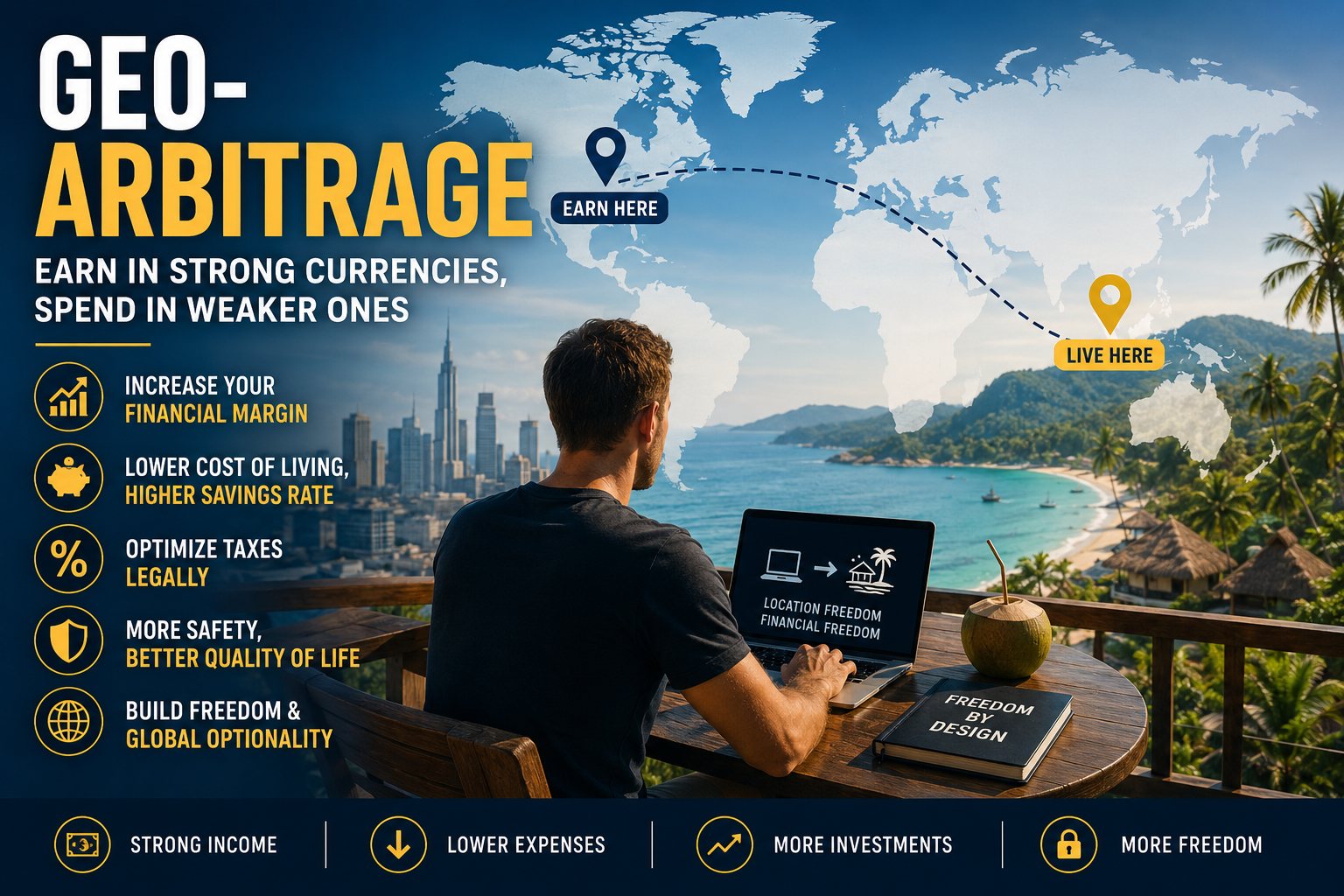
What Is Geo-Arbitrage? Earning in Strong Currencies, Spending in Weaker Ones
That is not entirely wrong. A higher income helps. A growing portfolio helps. A strong savings rate helps. But there is another side of the equation that many people ignore for far too long.
Most people think financial freedom is only about earning more money.
That is not entirely wrong. A higher income helps. A growing portfolio helps. A strong savings rate helps. But there is another side of the equation that many people ignore for far too long.
Where you live matters.
The same income can feel ordinary in one country and powerful in another. The same investment portfolio can feel fragile in an expensive city and surprisingly generous in a lower-cost country. The same monthly budget can buy stress in one place and margin in another.
That is the basic idea behind geo-arbitrage.
You earn, save or invest in a strong economic system, but you design your life in a place where your money goes further.
It sounds simple. But done properly, it is not just about cheap living. It is about freedom by design.
The Simple Definition
Geo-arbitrage means using differences between countries, cities or regions to improve your financial and personal situation.
The classic version is easy to understand. Someone earns money in dollars, euros or pounds, but lives in a country where housing, food, services, healthcare and daily life cost much less. The income stays strong. The expenses fall. The gap between the two becomes larger.
That gap is where financial independence accelerates.
But geo-arbitrage is not only about spending less. It can also involve lower taxes, better weather, safer communities, better healthcare access, easier residency, stronger asset protection or a lifestyle that fits your family better.
A cheap country is not automatically a good country. A low-tax country is not automatically a livable country. A beautiful beach is not automatically a wise base.
Geo-arbitrage is not the art of running away from expensive places. It is the art of choosing the right place for the life you are trying to build.
The Power of the Gap
Financial independence is built in the gap between income and expenses.
If you earn €5,000 per month and spend €4,700, your life may look comfortable from the outside, but your freedom is fragile. There is little margin. One unexpected bill, one job loss or one tax change can disturb the whole structure.
If you earn the same €5,000 but spend €2,500, everything changes. You now have room to invest, build cash reserves, reduce debt, take career risks, support your family, or simply breathe.
Geo-arbitrage can widen that gap without requiring you to double your income.
That is why it is so powerful.
Most people try to solve financial pressure only by earning more. But if every increase in income is absorbed by housing, taxes, commuting, childcare, insurance and general lifestyle inflation, the person may be richer on paper while still feeling trapped.
Geo-arbitrage asks a different question:
What if the problem is not only your income?
What if the problem is the place where your income is being consumed?
Earning Here, Living There
The modern world has made geo-arbitrage more practical than ever.
Remote work, online businesses, digital platforms, international investing and global banking have weakened the old connection between where you earn and where you live. For many professionals, entrepreneurs and investors, geography is no longer a fixed sentence.
A writer can earn from clients in the United States while living in Portugal, Paraguay or Thailand. An investor can receive dividends and distributions while living in a lower-cost jurisdiction. A consultant can serve international clients from a country with better weather, lower costs and less daily pressure.
Of course, this is not automatic. Visas, tax residency, banking, healthcare, schooling, safety and family needs all matter. But the old assumption that your life must be built around one expensive country is becoming weaker.
That is the opening.
Geo-arbitrage begins when you stop asking, “Where am I supposed to live?” and start asking, “Where does my life work best?”
Cheap Is Not Enough
The beginner’s mistake is to sort countries by cost of living and stop there.
That is dangerous.
A country can be cheap because it is inefficient, unsafe, unstable or difficult to navigate. Low rent does not help much if healthcare is poor, schools are unsuitable, infrastructure is weak, the legal system is unreliable or your family does not feel safe.
The right question is not:
“Where is the cheapest place to live?”
The better question is:
“Where do I get the best combination of cost, safety, lifestyle, tax treatment, healthcare, residency and long-term optionality?”
That question immediately improves the quality of the decision.
A family with children should think differently from a single digital nomad. A retiree should think differently from a young entrepreneur. A dividend investor should think differently from someone still building active income. A person seeking adventure should think differently from someone seeking stability.
The best country is not universal.
It depends on the job you need the country to do.
Freedom Is More Than a Slogan
A serious location decision should measure freedom in practical terms.
Can you keep more of what you earn? Can you protect your assets? Can your family live safely? Can you move money, invest, educate your children and build your life without excessive interference? Can you enjoy a high quality of life without surrendering too much control?
That is why freedom should not be reduced to politics or slogans. It should be tested in daily life.
The strongest countries for a globally minded investor are rarely perfect. Some offer low taxes but limited lifestyle fit. Some offer safety and excellent healthcare but high costs. Some offer attractive residency options but weaker infrastructure. Some are beautiful for a vacation but frustrating as a long-term base.
The point is not to find paradise.
The point is to compare trade-offs honestly.
Taxes Matter, But They Are Not Everything
Taxes are one of the biggest reasons people become interested in geo-arbitrage.
That makes sense. A high-income person in a high-tax country may lose a large part of every additional euro, dollar or pound to the state. An investor may also face taxes on dividends, capital gains, wealth, inheritance or rental income.
Lower-tax jurisdictions can therefore be attractive.
But tax is not the only factor.
A no-income-tax country may be expensive. A low-tax country may have weak infrastructure. A tax-friendly island may require significant capital. A country with attractive rules may not fit your family, values, language needs or schooling plans.
The goal is not to pay the lowest possible tax at any cost.
The goal is to build a legal, stable and livable structure where your money, family and future are treated better.
That is a very different mindset.
Safety Is Part of the Return
Investors often think about return only in financial terms.
That is too narrow.
A country with low costs and attractive tax rules may still be a poor choice if safety is weak. Crime, political instability, corruption, weak policing or social unrest can quietly destroy the quality of life that geo-arbitrage was supposed to improve.
Safety is not just about avoiding danger. It is also about peace of mind. Can your family walk outside comfortably? Can your children build a normal life? Can you focus on work and investing without constantly managing risk?
A cheap place that makes you anxious is not truly cheap.
It is expensive in a different currency.
This is why safety belongs inside the geo-arbitrage calculation. Not as an afterthought, but as a core factor.
Healthcare Is Part of the Plan
Healthcare is another overlooked part of geo-arbitrage.
Many people compare rent, groceries and restaurant prices, but forget medical access. That is a mistake, especially for families, retirees and anyone planning to stay abroad for more than a short adventure.
In some countries, private healthcare can be excellent and far cheaper than in high-cost Western systems. In other places, healthcare may be affordable but uneven. Some destinations are strong for routine care but weaker for complex procedures. Others have excellent medical tourism industries but may not be ideal for long-term living.
The point is simple: healthcare must be part of the plan.
Financial independence is not very independent if a medical emergency forces you back into a system you were trying to escape.
Mobility Is a Form of Wealth
A second passport, second residence or long-term visa can be more than paperwork.
It can be optionality.
Mobility gives you the ability to leave, enter, stay, invest, bank, educate your children and build a life across borders. It reduces dependence on one government, one tax system, one healthcare system and one political environment.
That does not mean everyone needs a second citizenship immediately. But it does mean globally minded investors should understand mobility as a serious asset.
A passport is not only a travel document.
It is a permission structure.
The more options you have, the less trapped you are.
The FireByMike Geo-Arbitrage Framework
Geo-arbitrage becomes much safer when you stop treating it like travel content and start treating it like a personal balance sheet.
You are not only comparing beaches, restaurants and apartment prices. You are comparing systems.
1. Income Source Can your income continue if you move? Is it remote, investment-based, business-based or local?
2. Cost of Living What happens to housing, food, transport, utilities, childcare, insurance and daily life?
3. Tax Residency Where are you legally tax resident, and how are income, capital gains, dividends and wealth treated?
4. Safety Can you and your family live calmly, move freely and build routines without constant concern?
5. Healthcare Is good medical care available, affordable and accessible when you need it?
6. Residency and Immigration Can you legally stay, renew, invest, work or build toward permanent residence?
7. Banking and Asset Protection Can you bank, invest, own property and protect assets reliably?
8. Education and Family Life Does the location fit your children, values, schooling plans, community needs and daily rhythm?
9. Lifestyle Fit Do the climate, language, culture, food, pace and social life actually fit you?
10. Exit Options If the country changes, do you have another place to go?
This framework will not choose a country for you. But it will protect you from the most common mistake: confusing a pleasant vacation with a serious life strategy.
Geo-Arbitrage and FIRE
Geo-arbitrage can be especially powerful for people pursuing FIRE: Financial Independence, Retire Early.
FIRE is usually built on a simple formula: earn well, spend less than you earn, invest the difference, and eventually allow your assets to support your life. Geo-arbitrage can improve that formula in two ways.
First, it can increase the savings rate during the accumulation phase. If you keep earning strong income while lowering living costs, more money can flow into investments.
Second, it can reduce the size of the portfolio needed for financial independence. A person who needs €70,000 per year to live comfortably may need a much larger portfolio than someone who can live well on €35,000 per year in a different location.
That does not mean everyone should move abroad.
It means location is part of the financial model.
Ignoring geography is like ignoring fees, taxes or inflation. It may not ruin the plan immediately, but it can make the journey much harder than necessary.
Geo-Arbitrage Is Not Escape
There is a shallow version of geo-arbitrage that sounds like escape.
Move somewhere cheap. Avoid responsibility. Live on the beach. Spend as little as possible. Post pretty pictures online.
That is not the FireByMike version.
The better version is more serious. It is about building a life where your capital, time, family and values are not constantly drained by a system that no longer fits you. It is about choosing jurisdictions with more care. It is about understanding that freedom is partly financial, partly legal, partly cultural and partly practical.
You are not looking for a fantasy.
You are looking for a better structure.
That is why geo-arbitrage belongs next to investing, tax planning, asset protection and long-term family strategy. It is not just lifestyle content. It is capital allocation applied to your life.
What Can Go Wrong?
Geo-arbitrage can fail when people move too quickly.
They visit a country for two weeks, fall in love with the weather, watch a few YouTube videos, and decide that the answer is obvious. Then they discover visa problems, banking friction, unexpected taxes, healthcare limitations, language barriers, school issues, internet problems, import duties or cultural fatigue.
The dream was not necessarily wrong.
The research was incomplete.
Good geo-arbitrage requires patience. Rent before buying. Test before committing. Understand the tax rules before changing residency. Visit in the bad season, not only the best season. Talk to families, not only influencers. Study healthcare, schools, banks, safety and exit options.
A beautiful place can still be a bad fit.
And a boring place can quietly be excellent.
The Bottom Line
Geo-arbitrage is one of the most powerful but misunderstood tools in the financial independence world.
At its simplest, it means earning in a strong currency and spending in a lower-cost location. But at its best, it means designing a life across borders with more margin, more optionality and less dependence on one expensive system.
The goal is not merely to live cheaply.
The goal is to live wisely.
A serious geo-arbitrage strategy compares cost of living, taxes, safety, healthcare, residency, banking, education, lifestyle and exit options. It does not confuse vacation with relocation. It does not chase the lowest rent. It does not treat tax savings as the only measure of freedom.
The right place should not only make your money go further.
It should make your life work better.
That is the real promise of geo-arbitrage.
Freedom is not found by accident.
It is designed.